In case you didn't see it already, here's a video I put together of a fun family outing over the weekend.
Thursday, June 18, 2009


God the Father: A Father’s Perspective
[this is a talk I gave on June 17/09 at the CSE Prayer Meeting, St. Boniface Pastoral Centre - it was recorded; you can listen or download it via this link]
Speaking about God the Father is a daunting task. Jesus himself spoke of God his father over fifty times in the Gospels, which to me says that there is a lot to say.
Approaching the topic from the perspective of an earthly father, while a narrower focus, is probably even more challenging. I must admit, having children has transformed my understanding of love and selflessness. Yet it is impossible for me to ponder the mystery of the heavenly father without being made very aware of my own parental shortcomings.
God’s love is perfect, after all. The story of the prodigal son (Luke 15:11-32) illustrates this most clearly, and it is the one burned into my mind’s eye with the most clarity. If you’re not familiar with it, here it is in a nutshell: the younger of two sons wants his inheritance early – basically implying to his dad, “I wish you were dead.” His dad grants him the money, and he takes off and lives a wild life, partying, drinking, sleeping around, and doing things which would scar him for the rest of his life, until one day the money runs out and his party friends abandon him.
Desperate, this young Jewish man finds a demeaning job tending to pigs, which are, in the Jewish tradition, among the most “unclean” of all animals. He finds his mouth watering as he watches the pigs eat their slop, and then suddenly he gets a brainwave. “I can go work at dad’s house and at least have a full belly.” In my mind this is another example of his selfish mind because even after all the hurt he has caused his father, he is still only thinking about himself. Yet, he goes home.
This is the part that really gets me.
The gospel says, “While he was still a long way off, his father saw him.” When I read this, I get the sense that his dad was watching, waiting. He had been the whole time. I picture an old man standing on the roof of his house so he can get a good view, and when the servants finally coax him down in the evening he sleeps in a room with an open window facing the road. While he sleeps, he leaves the candle burning to project his welcome, and faces the window to be better attuned to the first sound of footsteps. At daybreak the servants find him on the rooftop again, watching the distant road, trying to recognize his son’s gait in every passing traveler. They take his food to him there but he eats little. His mind, his body, his entire being is wrapped up in the fate of his lost son.
This, by the way, is what I think of when preparing for the sacrament of confession. It reminds me that God burns for me to come and to restore my friendship with him.
Finally, one day, his vigilance bears fruit and he sees his son. I imagine him flinging a plate of food off his lap, and opting for a faster descent than the stairs by jumping off the rooftop. He lands awkwardly and twists his ankle but the pain means nothing to him; he runs, runs, RUNS to his son, sobbing, embracing, kissing, shouting words bursting with love and deepest affection. The son starts into his prepared speech: “Father, I have sinned against heaven and against you…” but the father cuts him off and calls out for a robe and sandals and rings for his fingers and, “Kill the fatted calf, for tonight we celebrate!”
This son, who was hoping to live out the rest of his days quietly as a servant in a back room and without calling attention to his quite open shame, is restored to his place of honour and dignity in the father’s house. I don’t think it’s what he wanted, but it’s what the father had for him. He was not perfectly penitent, but he was back, and that allowed the father to shower him with love and blessings, which more than compensated for his imperfect act of contrition.
This is the love of a father for his son. This is the love of God the Father for you. For me.
It is difficult to step out of one’s adult or teenaged mind to accept this love. We are conditioned through countless influences to be self-sufficient, to be strong, to show no sign of weakness. Yet my young children are a continual reminder to me of the simplicity of a child’s love. My four daughters, ages two through eight, love me and actively show it through cuddles, kisses, words, and a desire just to spend time with me. My newborn son I’m sure is at least somewhat fond of me, and I am confident this will blossom into that same kind of love as he grows.
Often after receiving communion at Mass, I am holding one of my younger daughters. Every now and then she’ll be especially cuddly and cozy and will nestle deeply into my arms, head tucked down, gentle eyes blinking contentedly. She hopes that moment will never end.
In those moments I am reminded of Christ’s words in Matthew 18:3: “Unless you change and become like little children, you will never enter the kingdom of heaven.” This was his answer to the question of who is the greatest in the kingdom of heaven. Jesus wants us to trust and love his father with all the simplicity of a child’s mind.
So in those moments after communion, I try to visualize myself, a frumpy, overweight, awkward man, nestled snuggly in the arms of my heavenly father. It’s a funny mental picture, I admit, and the instinct to reject it is strong. But deep down I know it’s how God loves me; I know he longs to shower me with his affection and he wants me to spend time with him.
Let’s look a little deeper at the types of fatherly love shown in the tale of the prodigal son.
Speaking about God the Father is a daunting task. Jesus himself spoke of God his father over fifty times in the Gospels, which to me says that there is a lot to say.
Approaching the topic from the perspective of an earthly father, while a narrower focus, is probably even more challenging. I must admit, having children has transformed my understanding of love and selflessness. Yet it is impossible for me to ponder the mystery of the heavenly father without being made very aware of my own parental shortcomings.
God’s love is perfect, after all. The story of the prodigal son (Luke 15:11-32) illustrates this most clearly, and it is the one burned into my mind’s eye with the most clarity. If you’re not familiar with it, here it is in a nutshell: the younger of two sons wants his inheritance early – basically implying to his dad, “I wish you were dead.” His dad grants him the money, and he takes off and lives a wild life, partying, drinking, sleeping around, and doing things which would scar him for the rest of his life, until one day the money runs out and his party friends abandon him.
Desperate, this young Jewish man finds a demeaning job tending to pigs, which are, in the Jewish tradition, among the most “unclean” of all animals. He finds his mouth watering as he watches the pigs eat their slop, and then suddenly he gets a brainwave. “I can go work at dad’s house and at least have a full belly.” In my mind this is another example of his selfish mind because even after all the hurt he has caused his father, he is still only thinking about himself. Yet, he goes home.
This is the part that really gets me.
The gospel says, “While he was still a long way off, his father saw him.” When I read this, I get the sense that his dad was watching, waiting. He had been the whole time. I picture an old man standing on the roof of his house so he can get a good view, and when the servants finally coax him down in the evening he sleeps in a room with an open window facing the road. While he sleeps, he leaves the candle burning to project his welcome, and faces the window to be better attuned to the first sound of footsteps. At daybreak the servants find him on the rooftop again, watching the distant road, trying to recognize his son’s gait in every passing traveler. They take his food to him there but he eats little. His mind, his body, his entire being is wrapped up in the fate of his lost son.
This, by the way, is what I think of when preparing for the sacrament of confession. It reminds me that God burns for me to come and to restore my friendship with him.
Finally, one day, his vigilance bears fruit and he sees his son. I imagine him flinging a plate of food off his lap, and opting for a faster descent than the stairs by jumping off the rooftop. He lands awkwardly and twists his ankle but the pain means nothing to him; he runs, runs, RUNS to his son, sobbing, embracing, kissing, shouting words bursting with love and deepest affection. The son starts into his prepared speech: “Father, I have sinned against heaven and against you…” but the father cuts him off and calls out for a robe and sandals and rings for his fingers and, “Kill the fatted calf, for tonight we celebrate!”
This son, who was hoping to live out the rest of his days quietly as a servant in a back room and without calling attention to his quite open shame, is restored to his place of honour and dignity in the father’s house. I don’t think it’s what he wanted, but it’s what the father had for him. He was not perfectly penitent, but he was back, and that allowed the father to shower him with love and blessings, which more than compensated for his imperfect act of contrition.
This is the love of a father for his son. This is the love of God the Father for you. For me.
It is difficult to step out of one’s adult or teenaged mind to accept this love. We are conditioned through countless influences to be self-sufficient, to be strong, to show no sign of weakness. Yet my young children are a continual reminder to me of the simplicity of a child’s love. My four daughters, ages two through eight, love me and actively show it through cuddles, kisses, words, and a desire just to spend time with me. My newborn son I’m sure is at least somewhat fond of me, and I am confident this will blossom into that same kind of love as he grows.
Often after receiving communion at Mass, I am holding one of my younger daughters. Every now and then she’ll be especially cuddly and cozy and will nestle deeply into my arms, head tucked down, gentle eyes blinking contentedly. She hopes that moment will never end.
In those moments I am reminded of Christ’s words in Matthew 18:3: “Unless you change and become like little children, you will never enter the kingdom of heaven.” This was his answer to the question of who is the greatest in the kingdom of heaven. Jesus wants us to trust and love his father with all the simplicity of a child’s mind.
So in those moments after communion, I try to visualize myself, a frumpy, overweight, awkward man, nestled snuggly in the arms of my heavenly father. It’s a funny mental picture, I admit, and the instinct to reject it is strong. But deep down I know it’s how God loves me; I know he longs to shower me with his affection and he wants me to spend time with him.
Let’s look a little deeper at the types of fatherly love shown in the tale of the prodigal son.
- There is the love which endures abuses and insults, yet does not fade. It abides the “I wish you were dead” moments.
- There is the love which respects our free will. The father does not prevent his son from leaving, nor does he go out with a small army to bring his son forcefully home. His desire for our genuine act of free love drives this respect.
- There is the love which watches, undying, vigilant, ever-hopeful. Nothing can shake the father or distract him. He is singularly focused on the moment of his son’s return. Now most of you, if you’re here, you’re here because you’ve either already returned, or else you never left. But you must acknowledge that before your baptism and the restoration of your human dignity, at one point the father watched and waited for you.
- There is the love which restores us to our dignity at the slightest glimmer of our return to the father.
- There is the love which perfects our imperfect remorse. It completes the inarticulate cry of our soul; it tells on our behalf the whole story of our sorrow, for we are often too mired in our sin to comprehend it fully ourselves. You only need to start the process and turn to God to cry, “Help!” He’ll do the rest.
- There is the love which retains the temporal consequences of our sins despite the perfect forgiveness we receive. Later in the tale, the father tells his elder son, “All I have is yours.” The inheritance which the younger son squandered is gone forever, despite the father’s open re-acceptance of him. This may seem illogical, but look deeper and you will realize that it actually reflects perfectly the dignity to which we have been restored. The father’s standards of good behaviour have not changed, despite our sin or his forgiveness. We are still expected to follow his commands and to reap the harvest we have sown.
- There is the love which perceives the pain and disunity the sins of one cause to the family as a whole.
- There is the love which rewards the faithfulness of the father’s elder son in the next life. “My son, you are with me always, and all I have is yours.” It is a better thing never to stray from his love.
- There is the love which rebukes the arrogance of the self-righteous ones who scorn the return of the sinner, reminding them that there is more cause to celebrate the salvation of a lost one than the fidelity of the faithful.
Pondering this parable makes me wonder if my own love for my children would be so perfect were one or more of them to stray from the faith.
In those moments I draw strength from the love God the father showed for me, for I know that I too have been lost and have returned to his embrace on many occasions.
If, heaven forbid, a child of mine turns from the love of God, I pray that God will give me the strength and depth of fatherly love to sit on my rooftop, watching day and night. After all, he did it for me.
Monday, May 11, 2009
Decreasing Frequency
(Click to enlarge)
 This was all I could figure into why I haven't been blogging much as of late.
Hmm.
.
Sunday, April 12, 2009
The Pope's Ailing Health, Redux
This author of this AP article about the Pope's Easter homily is taking a page from the media's playbook from the last ten years of John Paul II's life: throw in extraneous references to his ailing health.
It begins the third sentence in: "The 81-year-old pope tripped as he climbed up to his gilded chair on the loggia, but recovered without incident and delivered his speech to the crowds below."
It's almost like the reporter is secretly hoping for a trip which results in a plummet off the balcony, or at least a nasty gash to the forehead.
It goes on: "Benedict celebrated Easter Mass after presiding over the solemn, three-plus-hour Easter Vigil ceremony Saturday night. At the end of that service, Benedict sounded hoarse and looked tired. But the pope — who turns 82 on Thursday — appeared well-rested by Sunday morning and held up well throughout the Mass."
Everybody, use your most patronizing tone and say it with me: "Oh, good for him."
Is this really news? An 82 year old man naturally can't be expected to retain his voice after presiding over a 3+ hour Mass. There's a guy named Joe in our church who has got to be pushing 90. Why not a gripping exposé on how he did for the Easter Vigil?
.
It begins the third sentence in: "The 81-year-old pope tripped as he climbed up to his gilded chair on the loggia, but recovered without incident and delivered his speech to the crowds below."
It's almost like the reporter is secretly hoping for a trip which results in a plummet off the balcony, or at least a nasty gash to the forehead.
It goes on: "Benedict celebrated Easter Mass after presiding over the solemn, three-plus-hour Easter Vigil ceremony Saturday night. At the end of that service, Benedict sounded hoarse and looked tired. But the pope — who turns 82 on Thursday — appeared well-rested by Sunday morning and held up well throughout the Mass."
Everybody, use your most patronizing tone and say it with me: "Oh, good for him."
Is this really news? An 82 year old man naturally can't be expected to retain his voice after presiding over a 3+ hour Mass. There's a guy named Joe in our church who has got to be pushing 90. Why not a gripping exposé on how he did for the Easter Vigil?
.
The Humour of John
The Apostle John is believed to have authored (or had very close connection to authoring) the fourth Gospel. In it, he always references himself in the third person as "the disciple whom Jesus loved" (itself a profound statement of his humility and his wonder).
He really seems to have enjoyed writing the account of the Resurrection.
And I don't mean strictly from a spiritual sense. I mean that, if you read it closely enough and remember that we're talking about a translation from a foreign language whose culture was 2000 years separated from our own, there seems to be a bit of a dig at the Apostle Peter.
Take a close look (emphasis added):
Maybe I'm way off base on this, but it almost seems like John is sending a subtle jibe against Peter. It's like he's saying, "When we heard the tomb was empty, Peter and I ran towards it. I beat him there. Sure, he went in first, but I beat him there."
This is the type of friendly banter which two dear friends can engage in. Peter, being considered the first Pope, naturally commands the respect of John, but it's clear that their friendship transcended the hierarchical structure of the Church.
What do you think? Does anybody else see that joke in there?
.
He really seems to have enjoyed writing the account of the Resurrection.
And I don't mean strictly from a spiritual sense. I mean that, if you read it closely enough and remember that we're talking about a translation from a foreign language whose culture was 2000 years separated from our own, there seems to be a bit of a dig at the Apostle Peter.
Take a close look (emphasis added):
Now on the first day of the week Mary Magdalene came early to the tomb, while it was still dark, and saw the stone already taken away from the tomb. So she ran and came to Simon Peter and to the other disciple whom Jesus loved, and said to them, "They have taken away the Lord out of the tomb, and we do not know where they have laid Him." So Peter and the other disciple went forth, and they were going to the tomb. The two were running together; and the other disciple ran ahead faster than Peter and came to the tomb first; and stooping and looking in, he saw the linen wrappings lying there; but he did not go in. And so Simon Peter also came, following him, and entered the tomb; and he saw the linen wrappings lying there, and the face-cloth which had been on His head, not lying with the linen wrappings, but rolled up in a place by itself. So the other disciple who had first come to the tomb then also entered, and he saw and believed.
Maybe I'm way off base on this, but it almost seems like John is sending a subtle jibe against Peter. It's like he's saying, "When we heard the tomb was empty, Peter and I ran towards it. I beat him there. Sure, he went in first, but I beat him there."
This is the type of friendly banter which two dear friends can engage in. Peter, being considered the first Pope, naturally commands the respect of John, but it's clear that their friendship transcended the hierarchical structure of the Church.
What do you think? Does anybody else see that joke in there?
.
In The Beginning, There Was Me
If you pause to look back in the most ancient recesses of your memory, to find the earliest memory you have, you will be struck, as have I, by one singular fact.
I am all I know.
Despite my intricate intimacy with my wife, my profound knowledge of the character of my children, my participation through childhood with my siblings, and even my knowledge of the three persons of the Trinity, formed through decades of reading Scripture, the teachings of the Catholic Church, the writings of the saints, and the various smatterings of wisdom from my brethren in Christ over the years... in the beginning, I am all I know.
And yet as well as I know myself, the knowledge that God has of me is far deeper. Even the great Saint Paul wondered why he did the things he didn't want to do; I too am continually puzzled by my impulses. What makes me tick?
God knows.
Literally, God knows.
For in the beginning - the REAL beginning - God was. If I believe the words of Scripture, he formed me from my beginning. For some reason, he deemed it appropriate that my originating sperm cell, among millions (yay Dad!) should unite with the ovum, and here I am.
The mystery of Christ's suffering and death on a cross makes this truth all the more powerful. For if God knows me better than reality lets me know myself, and if he should suffer and die to free me from my sins and to welcome me into everlasting bliss, does this not elevate my (or reveal my elevated) status as a human being?
An old hymn says:
The paradox of Christianity is that I can acknowledge fully that I am a worm of a man: sinful, lost, careless, hopeless, loveless... and yet once I accept the warm embrace of Christ, restoring me to the love of God Almighty, I am a king and a priest; a heavenly nobleman. My worth comes from the fact that in the beginning (my beginning), I was spawned into existence because God willed it.
This thought occurred to me after receiving Communion at the Easter Vigil Mass on Holy Saturday. When it all comes down to it, it's just me and God. Everything else fades to black when I ponder his love for me. Everything else in my life could vanish - my wife and kids, my job, my blog - and if I am left with nothing but my knowledge that God specifically called me into existence out of nothingness, I will still be blown away by his love.
For I know that my redeemer lives.
.
I am all I know.
Despite my intricate intimacy with my wife, my profound knowledge of the character of my children, my participation through childhood with my siblings, and even my knowledge of the three persons of the Trinity, formed through decades of reading Scripture, the teachings of the Catholic Church, the writings of the saints, and the various smatterings of wisdom from my brethren in Christ over the years... in the beginning, I am all I know.
And yet as well as I know myself, the knowledge that God has of me is far deeper. Even the great Saint Paul wondered why he did the things he didn't want to do; I too am continually puzzled by my impulses. What makes me tick?
God knows.
Literally, God knows.
For in the beginning - the REAL beginning - God was. If I believe the words of Scripture, he formed me from my beginning. For some reason, he deemed it appropriate that my originating sperm cell, among millions (yay Dad!) should unite with the ovum, and here I am.
The mystery of Christ's suffering and death on a cross makes this truth all the more powerful. For if God knows me better than reality lets me know myself, and if he should suffer and die to free me from my sins and to welcome me into everlasting bliss, does this not elevate my (or reveal my elevated) status as a human being?
An old hymn says:
Alas! and did my Savior bleed
And did my Sovereign die?
Would He devote that sacred head
For such a worm as I?
The paradox of Christianity is that I can acknowledge fully that I am a worm of a man: sinful, lost, careless, hopeless, loveless... and yet once I accept the warm embrace of Christ, restoring me to the love of God Almighty, I am a king and a priest; a heavenly nobleman. My worth comes from the fact that in the beginning (my beginning), I was spawned into existence because God willed it.
This thought occurred to me after receiving Communion at the Easter Vigil Mass on Holy Saturday. When it all comes down to it, it's just me and God. Everything else fades to black when I ponder his love for me. Everything else in my life could vanish - my wife and kids, my job, my blog - and if I am left with nothing but my knowledge that God specifically called me into existence out of nothingness, I will still be blown away by his love.
For I know that my redeemer lives.
.
Saturday, April 04, 2009
The Tyranny of Self Improvement
I'm at a point in my life right now where I am being forced to grow in many areas. My job is challenging - not beyond possibility, but enough outside of my comfort zone that I'm required to stretch. My family life has reached a new level of chaos. My volunteer work at our church and school are requiring increased diligence and responsibility. And through this all, I hear the call of God to simplify, to live life as frugally as possible, and to stay connected to him through prayer.
So growth is happening. Some would call it maturity.
The last time God brought me through such an intense phase of maturity was right before I met my wife. As a teenager, I was constantly lovesick. I needed a girlfriend in the worst way. I knew I was a catch and couldn't figure out why the young ladies I knew didn't seem to realize it. My desperation reached a frenzied pitch until one day God led me to a book called "Wide My World, Narrow My Bed" by Luci Swindoll. In reading it, he challenge me to abandon the hunt for a girlfriend/wife and instead to be content being single.
It took me some time, but I got there. Then he really rocked my world.
"Now James," he said to me, "I want you to be happy being single."
That was a difficult step. "Content" I could do; peace comes easily to me. But "happy"... that was another thing entirely. It meant giving up my quest for what I thought would bring me happiness and to surrender not just my heart to Jesus but my mind as well. It meant to find joy in what I had up to that point perceived as the ultimate despair: being alone.
So I rebelled. Not openly, mind you. I was never the kind of guy to sleep around or go drinking or experiment with drugs. But in my spirit, I said NO to God. I turned away, and although I kept up appearances, for a time I abandoned the concept of believing that God loved me. Over the course of several months, he wooed me back, and I did reach that point where I was able to think about the single life and genuinely smile about it.
God appreciates irony, and it was about two weeks later that I met my wife. Although I was puzzled at God's timing then, it makes perfect sense to me now. He does want me to be happy, but he wants my happiness to come from following his plan for my life instead of my own plan. If I had met Dawn in my own frantic search for the perfect woman, I would not have been wise enough to know I had found her.
Anyway, the point of that story is that right now I'm at a point in my current life where God is saying to me, "You enjoy your down-time and your relaxation, but I want you to give those up and take on the work of the kingdom. I want you to sacrifice your own idea of what will bring you rest and trust me to provide rest for you. You say you don't want to be one of those people who takes on too much; I want you to abandon your idea of what is too much and respond to my call."
So here I am. I am struggling not to rebel against this new direction.
I believe that part of this journey will require me to become more capable in my public speaking, so I am joining a local Toastmasters club. This morning I came back from my second meeting. At the end of the meeting, we all cast ballots on who was the best speaker, best evaluator, best dressed, etc. Today I won an award, and I suspect that I shall be a frequent recipient of this one:
.
So growth is happening. Some would call it maturity.
The last time God brought me through such an intense phase of maturity was right before I met my wife. As a teenager, I was constantly lovesick. I needed a girlfriend in the worst way. I knew I was a catch and couldn't figure out why the young ladies I knew didn't seem to realize it. My desperation reached a frenzied pitch until one day God led me to a book called "Wide My World, Narrow My Bed" by Luci Swindoll. In reading it, he challenge me to abandon the hunt for a girlfriend/wife and instead to be content being single.
It took me some time, but I got there. Then he really rocked my world.
"Now James," he said to me, "I want you to be happy being single."
That was a difficult step. "Content" I could do; peace comes easily to me. But "happy"... that was another thing entirely. It meant giving up my quest for what I thought would bring me happiness and to surrender not just my heart to Jesus but my mind as well. It meant to find joy in what I had up to that point perceived as the ultimate despair: being alone.
So I rebelled. Not openly, mind you. I was never the kind of guy to sleep around or go drinking or experiment with drugs. But in my spirit, I said NO to God. I turned away, and although I kept up appearances, for a time I abandoned the concept of believing that God loved me. Over the course of several months, he wooed me back, and I did reach that point where I was able to think about the single life and genuinely smile about it.
God appreciates irony, and it was about two weeks later that I met my wife. Although I was puzzled at God's timing then, it makes perfect sense to me now. He does want me to be happy, but he wants my happiness to come from following his plan for my life instead of my own plan. If I had met Dawn in my own frantic search for the perfect woman, I would not have been wise enough to know I had found her.
Anyway, the point of that story is that right now I'm at a point in my current life where God is saying to me, "You enjoy your down-time and your relaxation, but I want you to give those up and take on the work of the kingdom. I want you to sacrifice your own idea of what will bring you rest and trust me to provide rest for you. You say you don't want to be one of those people who takes on too much; I want you to abandon your idea of what is too much and respond to my call."
So here I am. I am struggling not to rebel against this new direction.
I believe that part of this journey will require me to become more capable in my public speaking, so I am joining a local Toastmasters club. This morning I came back from my second meeting. At the end of the meeting, we all cast ballots on who was the best speaker, best evaluator, best dressed, etc. Today I won an award, and I suspect that I shall be a frequent recipient of this one:
.
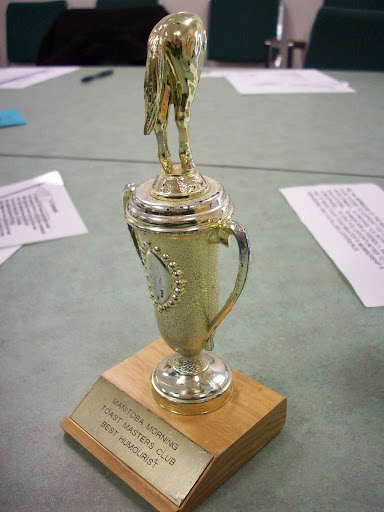
In case you can't make it out, it is the award for Best Humourist. The trophy itself is a horse's rear end.
..
Saturday, March 28, 2009
Thursday, March 19, 2009
So This Is What It's Like To Have A Doofus On The Other Side In Charge
You know, somehow, during all those years of the Bush presidency, through all the foibles and goofs and live bloopers, it was nice to see that he never lost his cool. Still, lots of people poked fun at him. This guy calls him an "idoit" - yes, you read that right:
Bush always held his composure, and never let it get to him. Just watch the cocky look in his eye at the end of the video: You can almost hear him thinking, "Nyah nyah, you missed me!"
Obama, though, strikes me as something more severe than a country bumpkin. He was presented to the world through the slick party machine as a smooth talker, a profound thinker, a savant. Oh, how the mighty have fallen.
Now even his teleprompter is turning against him.
.
Bush always held his composure, and never let it get to him. Just watch the cocky look in his eye at the end of the video: You can almost hear him thinking, "Nyah nyah, you missed me!"
Obama, though, strikes me as something more severe than a country bumpkin. He was presented to the world through the slick party machine as a smooth talker, a profound thinker, a savant. Oh, how the mighty have fallen.
Now even his teleprompter is turning against him.
.
Sunday, March 01, 2009
In Case This Blog is Your Only View Out From Under a Rock...
...you'll be delighted to hear that my wife has given birth to our fifth* child.

(Perhaps my title isn't fair; I know that many of my readers are separated from us by distance and non-Facebookiness.)
Our son - yes, our SON, if you can believe it - took his first breath at 8:25 AM on Feb 27. He was 9 lb 9 oz, and 22 inches long. His name is Benedict Robert Joachim Kautz. Mom and baby are home and all is well, aside from a cold bug circling through our home.
.
The girls are enthralled and want to keep poking him.
.
.
Subscribe to:
Comments (Atom)